

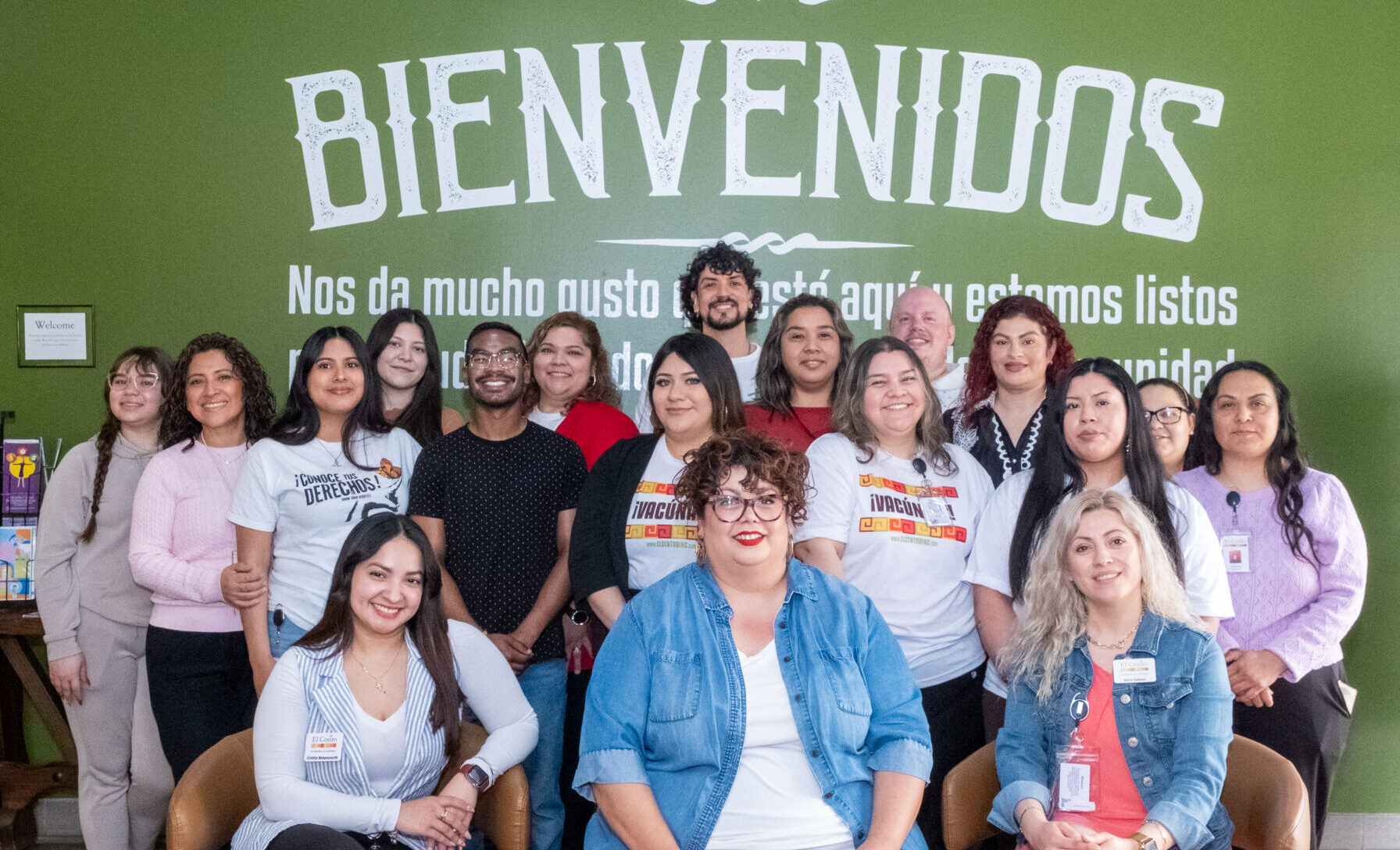
“Being a trusted site is our sacred duty.” That’s how Erica Andrade, President and CEO of El Centro, described the organization’s role across Wyandotte and Johnson counties. Nearly 50 years after its founding to fight racism and serve a growing immigrant workforce, El Centro remains a Spanish-first, community-rooted hub for health navigation, education, economic empowerment, and advocacy.
“El Centro is proudly a Spanish-first organization, which to us means that everything that we do, from the moment somebody calls or walks in our door, is done in Spanish,” Andrade said. “Our staff reflects the communities they serve.”
El Centro operates three sites: two in Kansas City, KS, and one further south in Olathe, KS. However, Andrade made a point to clarify that El Centro’s services and resources aren’t bound by state lines, stating, “We always say, whoever can come to us, we’re going to serve them. We do get some Missouri clients that come in, and we just try to service them the same way.”
That open-door philosophy extends into every aspect of El Centro’s work. Their Academy of Children, a dual-language preschool accredited by the National Association for the Education of Young Children, nurtures bilingualism as a strength rather than a barrier. Health navigation programs connect families to public benefits, providers, and health care services. Promotoras de Salud (community health promoters) offer peer-to-peer education, creating trusted pathways into a health system that often feels inaccessible. At the same time, financial literacy classes, Individual Taxpayer Identification Number assistance, Volunteer Income Tax Assistance, tax preparation, small business workshops, and homeownership support the organization’s work to build economic stability. Civic participation and policy advocacy are woven throughout every program, ensuring that Latino voices are heard and amplified in decision-making spaces.


“We’re constantly trying to look for ways that we can advocate for the community that we serve, amplify their voices in the spaces where it’s not commonly heard, and really always trying to push for more equity and inclusiveness in all of the public services and policies that are around the members of our community, from the schools to the health care institutions to our state house,” Andrade said.
Their approach to advocacy is more than policy-focused; it is about building trust in moments when the surrounding cultural and political environment is fragile. While many institutions still struggle with language barriers or bureaucratic hurdles that discourage participation, El Centro uses a straightforward and human approach to connecting and building authentic relationships with Latino community members, meeting them where they are.
This commitment became especially critical when immigration enforcement actions surged in Kansas. Families, fearful of being targeted, pulled back from community engagement and accessing critical resources. Attendance at El Centro, along with program enrollment, dipped notably overnight. Rather than shrinking under the weight of fear, Andrade and her team leaned in, offering clarity, reassurance and tangible educational support.
To create a safe and secure environment for the community, El Centro has implemented safety protocols and provided comprehensive staff training. Beyond their doors, they have extended these services through outreach to Latino-owned businesses and restaurants, offering resources such as “Know Your Rights” education and legal guidance to help community members navigate immigration-related challenges with confidence and support. These protections are increasingly vital as Immigration and Customs Enforcement (ICE) raids continue to play out across the country.
The threats extend beyond immigration enforcement. Federal policy shifts, like the passage of H.R. 1 (The One Big Beautiful Bill Act) strip healthcare access and vital benefits from immigrant and refugee families, even those here legally. Contrary to rhetoric, undocumented citizens are generally not eligible for programs like Medicaid and Supplemental Nutrition Assistance Program (SNAP). However, the chilling effect of this legislation has been immediate. People eligible for programs like SNAP or Medicaid, especially those in mixed status families, now hesitate to apply and are worried that enrollment could expose their loved ones to immigration authorities. Even the trust once placed in data protection has eroded, as clients grow increasingly wary of who might see their personal information if they apply for support. The result is an increase in children and families going without health insurance coverage and access to affordable care.
El Centro’s response has been to double down on radical transparency. Families are guided through eligibility without assumptions, and are given clear and complete information, to make their own well-informed decisions. “First, you provide the information, then you move into education, where it’s a back-and-forth. Everything is about informed consent. You give people the information and then you allow them to choose,” said Andrade. This approach empowers families while acknowledging the ongoing shifts in policy and program eligibility.
Despite fear and uncertainty, the Latino community continues to build. El Centro’s matched-savings homebuyer program is helping families achieve dreams of homeownership. Business classes remain full of aspiring Latino entrepreneurs eager to start and grow ventures that strengthen their community. “People are still building dreams,” Andrade reflected. “That reinforces for me that we have to keep doing the work.”
For Justin Gust, vice president of community engagement, the resilience and connectedness of the community is inspiring. “I think for me, having a different perspective as a white man, non-Latino, I’m almost a bit jealous of the connectedness in the Latino community. You see families coming together to take care of each other in ways we tend to monetize in white communities. That collective care is so powerful.”


As Hispanic Heritage Month encourages the nation to reflect on culture and identity, Andrade emphasizes that honoring language and tradition shouldn’t be confined to one month. “Culture should always be celebrated, not just your own, but others’ too. Being willing to lean and experience new things makes us all stronger.”
As for funders and partners, the lesson is equally clear: good intentions must be paired with preparation and respect. “Organizations will come to us saying, ‘We want to pilot this program for the Latino community, can you connect us?’ But they haven’t fully thought through the process,” Gust noted. “In some cases, it’s something we already offer in Spanish.”
In addition, Andrade underscored the broader point, stating, “This isn’t just about the Latino community. It’s about DEI in practice. Are these values you truly hold, or are they just talking points during Hispanic Heritage Month or Black History Month? Advocacy doesn’t belong to one person; it’s the responsibility of everyone. And right now, we need allies who will protect those values when they’re under fire.”
REACH Healthcare Foundation has been a proud partner of El Centro for over a decade.
Through trust, transparency, and advocacy, El Centro demonstrates what it takes to keep communities safe, connected, and thriving, even in the face of fear and misinformation.
Learn more about El Centro and the organization’s work at elcentroinc.com.